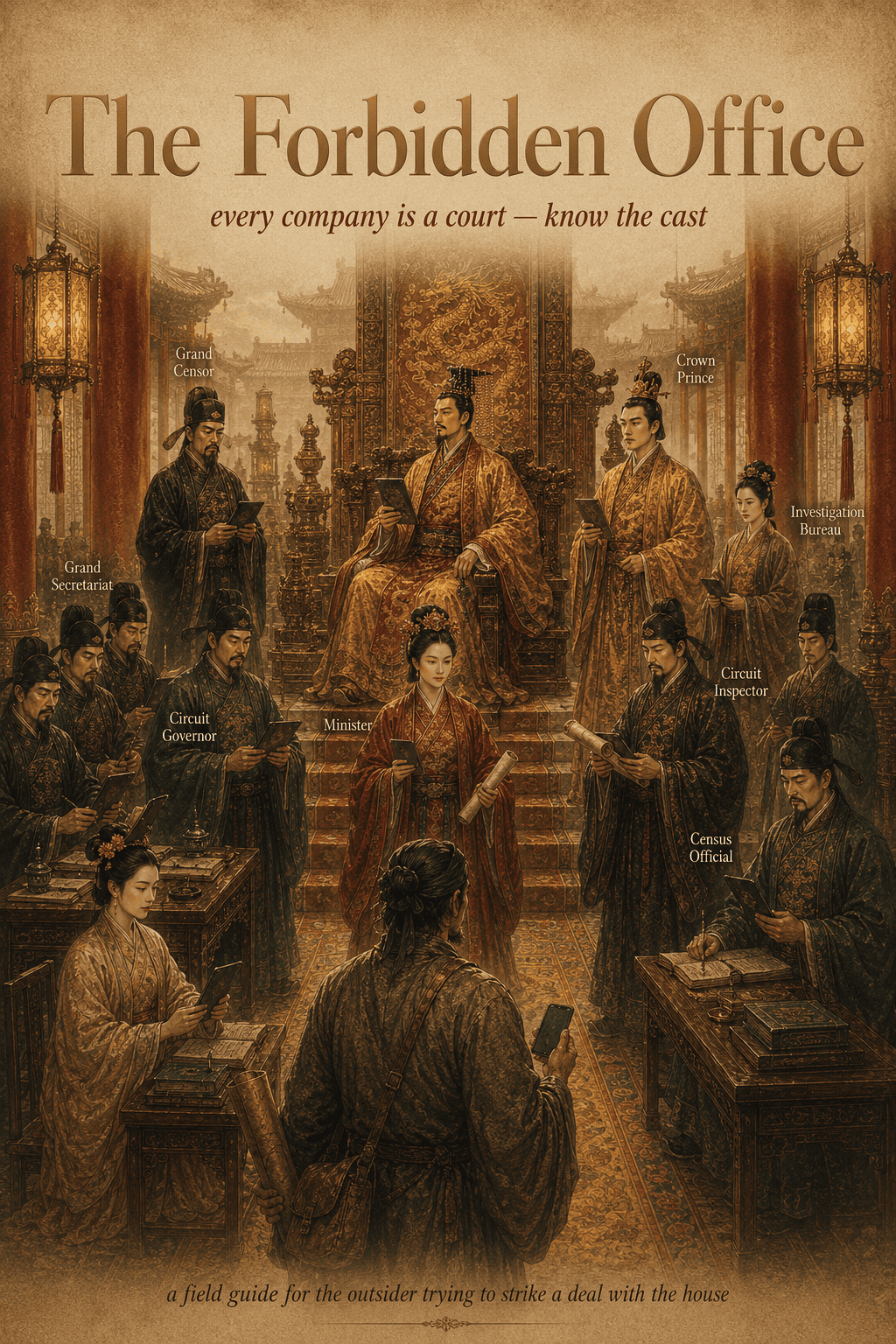
The Forbidden Office — front cover
The Forbidden Office
Every court has a structure most envoys never learn until after the deal. You've just seen it from the inside.
A Field Guide for the Outsider
Click the cover to dive in · right page / → turns, left page / ← goes back · click an image to enlarge · cover · end
The Forbidden Office — front cover
swipe to turns pages →
使
使
Before you walk in

Who you are in this

You are the Envoy — an outsider come to strike a deal with a house that is not yours.

The Envoy entering the forbidden office

You don't sit on the throne and you're not on staff. You come with a proposal, a sponsor who opened the door, and the job of earning a yes from the seats that actually decide. The merits of your deal are rarely the problem. This guide is everything around the merits — where the power sits, who to win, and why the questions that feel like obstacles are usually just the machine working as designed.

  • A yes is a door, not a deal. A sponsor wanting it gets you in the room — it doesn't commit the house to execute.
  • Power is structural. It sits on the seat and the decision it holds — not on age, warmth, or tenure.
  • Scrutiny is the job. The hard questions are due diligence, not a personal attack.
  • Win the gatekeeper, never fight them. A good deal dies on conduct far more often than on numbers.
The cast

The Court at a Glance

Each seat maps to a real role inside a large organization. Learn the map — then meet each one in turn.

The EmperorThe ownerUltimate authority; rarely acts. Their yes opens a door, not a deal.
The Crown PrinceThe sponsor / heirOpens the door and backs you — through the court, not around it.
The Grand SecretariatBoard of DirectorsFinal governance. The case must arrive already clean.
The Grand CensorAudit & Supervisory BoardIndependent; answers only upward. Watches everyone.
The Royal TreasuryInvestment CommitteeThe capital gate for large deals; above the Minister.
The CensorateCompliance CommitteeSets the rules everyone else enforces.
The MinisterPresident & CEOHolds the operational pen. Their yes is the deal.
The Circuit InspectorCompliance OfficerPen on small deals; shapes what the Minister sees on big ones.
The Court OfficialsThe company — anyone, any rankNot in your deal room — but every impression they form travels upward.
The Investigation BureauCompliance DepartmentIn every room; their notes become the record.
The Census OfficialFinance & PlanningThe numbers gate — weak financials die here first.
The Circuit GovernorInside operator who brings you inManages you and the bureau; answers for a clean process.
The EnvoyYou — the outside partnerThe seat this whole guide is written for.
How a deal moves

The deal path

Every deal follows the same gates. The route is fixed — what changes is how cleanly you move through it.

Typical deal path — read upward from where you stand
SPONSOR'S HOUSE THE DEAL PATH OVERSIGHT The Emperor above all · rarely acts directly Grand Secretariat board · final ratification Royal Treasury capital gate · only if funding required The Minister holds the pen · operational yes or no Census Official numbers gate — weak financials stop here Circuit Inspector Bureau in every meeting · compliance check The Envoy — You the outside partner bringing the deal 1 2 3 4 if capital needed 5 if board- level Crown Prince sponsor · opens doors above you Circuit Governor brought you in · manages both sides accountable for you to the court The Grand Censor independent · watches all · throughout The Censorate sets rules governing all gates ↑ applies across the full path The Court Officials — everyone · any rank · any function · impressions form in every corridor
Governance
Gate / decision
Sponsor's House
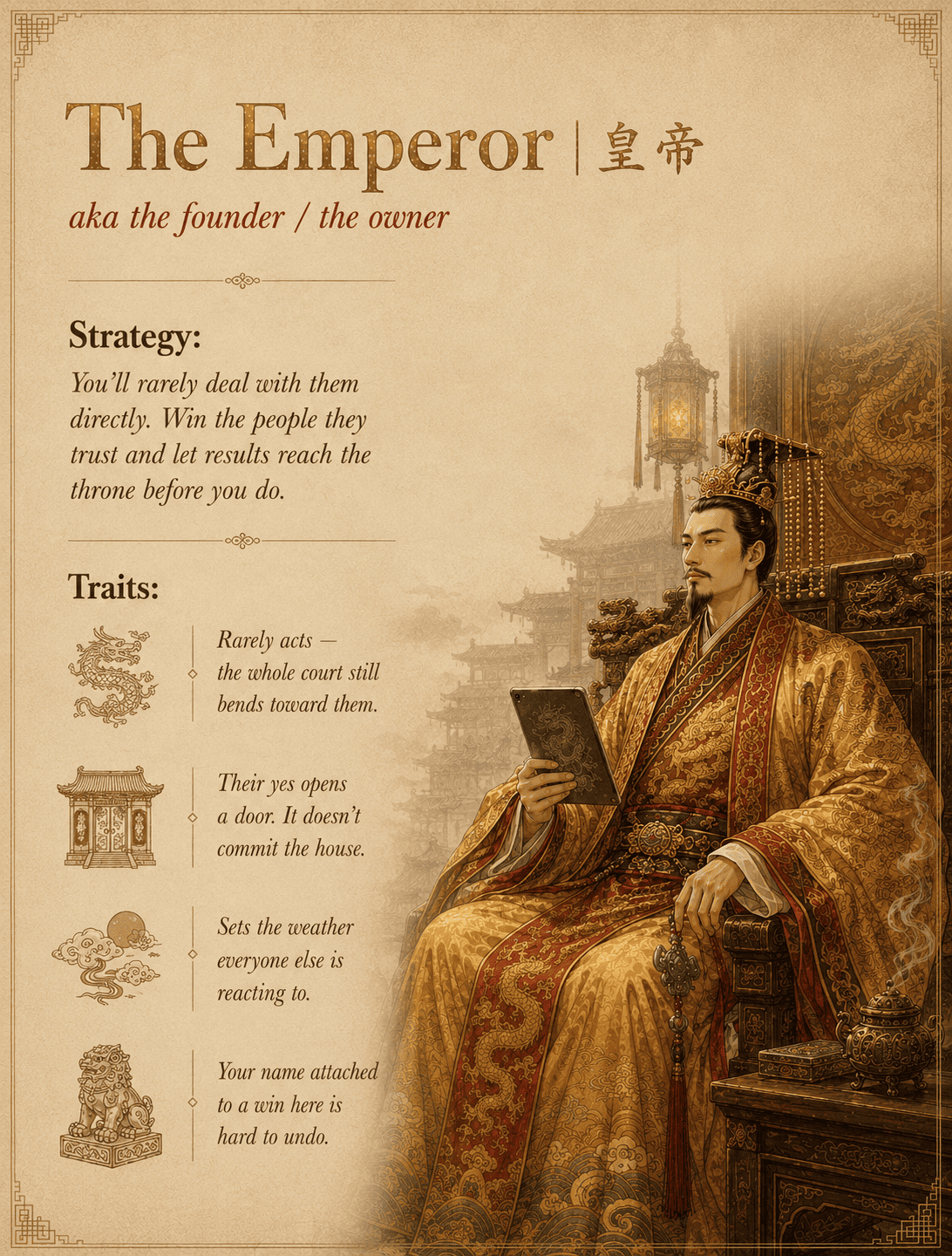
The Emperor
The Emperor
The founder / the owner — the whole court bends toward them.
The Throne
Where the power comes from

They rarely act — and the whole court still bends toward them. Their authority is gravitational, not operational: they set the direction and the standards everyone below is reacting to. You almost never deal with them directly, and that's the point.

Upside

A win attached to their name is durable — hard for anyone below to unwind once the result has reached the throne.

Risk

Their yes is easily misread as the deal. It opens a door and earns goodwill; it does not commit the organization to execute.

Works

Win the people they trust and let clean results climb to them on their own. Make the people around the throne look right for backing you.

Backfires

Reaching for them directly, or treating their enthusiasm as a mandate that overrides the court. The court still has to do its job.

Watch-out · their yes is a door, not a deal

A founder's "I want this" begins a process — it doesn't end one. Treat it as your strongest opening, then go earn the rest from the seats that carry the work.

The Crown Prince
The Crown Prince
The sponsor and heir — backing you while building his own mandate.
Your Sponsor
Where the power comes from

Proximity to the throne, plus a name he's still building. An anointed heir hasn't yet earned his own legitimacy — so he backs deals that become evidence he can run the house. His support is real, but it flows through the court, not over it.

Upside

He can fast-track you, shield you, and open corridors you'd never find alone — he knows where every passage leads.

Risk

The same map that protects you can be folded away the moment you become a liability. Your failure is his problem.

Works

Make the deal pay off so visibly that backing you strengthens his standing. Arm him to advocate for you in rooms you'll never enter.

Backfires

Treating his "yes" as an override of the court's process. He won't burn his legitimacy to save your deal.

Watch-out · he builds his mandate through the court, not around it

Don't assume proximity to the founder means an easy path. An heir under watch is often a more rigorous gatekeeper — a bad bet on borrowed authority costs him more than it costs you.

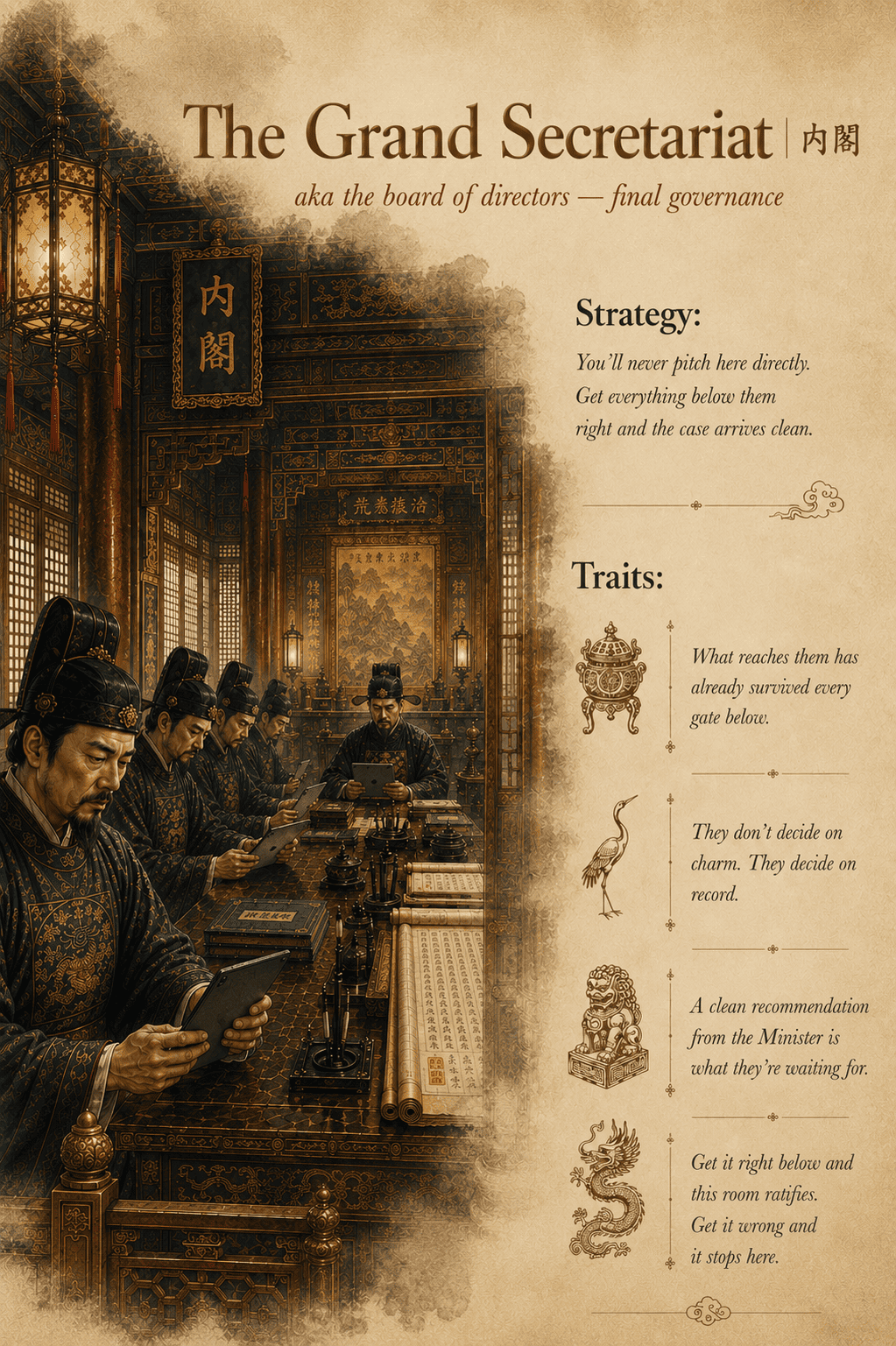
The Grand Secretariat
The Board — where a clean case is sealed or a flawed one quietly dies.
The Board
Where the power comes from

Final governance. By the time anything reaches this room, every gate below has already vouched for it — so they're not weighing your pitch, they're trusting the record built beneath them. They ratify, or they stop.

Upside

A deal that arrives here cleanly is sealed — the highest, most durable form of yes the house can give.

Risk

One unresolved risk carried up from below, and this is where the deal quietly dies — no argument, no appeal.

Works

You'll rarely pitch here directly. Get every gate below exactly right so the case lands already vouched for, and let the structure carry you up.

Backfires

Trying to leap straight to the top, or arriving with anything unresolved beneath you. Nothing reaches this room raw and survives.

Watch-out · reaching them is rare — but not impossible

A big enough deal rises to this room, and a partner who grows important enough stops pitching it and starts sitting in it. The ceiling moves if you become a partner the house can't ignore.

The Grand Censor
The Grand Censor
Audit & Supervisory Board — independent, answering only upward.
Independent
Where the power comes from

Independence. They answer only upward — outside your reporting line, outside the Minister's, outside everyone's. Their standing right is to ask "is this sound?" and be heard at the very top. They watch the watchers, the Board included.

Upside

There's nothing to court here — only exposure to avoid. A clean record satisfies them, and the same discipline protects you everywhere else.

Risk

You can't befriend or charm your way past them. Even after a deal closes, the records can trace trouble back to your name.

Works

Keep conduct and documentation clean at every level, from the first meeting. Assume everything is on the record — because to them, it is.

Backfires

Trying to manage them through your sponsor, or cutting a corner because no one flagged it. Both surface here, with your name attached.

Watch-out · you cannot manage them

They're not in your reporting line and never will be. The only defense is a clean record — there's no relationship to lean on and no argument that outranks the audit.

The Royal Treasury
The Royal Treasury
The Investment Committee — capital above the Minister.
Capital
Where the power comes from

They control capital. Sitting above the Minister, they decide whether a deal gets the money to happen at all — strategic fit and financial discipline, weighed together. Capital is their language, and vague projections die in it.

Upside

Their backing turns an approved deal into a funded one. Meet them cleanly in numbers and you clear the gate most deals stall at.

Risk

You're competing against every other deal in the house for the same finite capital. A weak case doesn't just fail; it loses.

Works

Bring clean numbers, a structured case, and the risk named out loud. Speak their language — return, downside, P&L — not enthusiasm.

Backfires

Overselling the numbers even once. They'll doubt every figure you bring afterward — and a treasury that distrusts your math doesn't fund you.

Watch-out · capital outranks operations here

A Minister can want your deal and still watch the Treasury shelve it. Arrive already pre-cleared on the numbers — strategic fit alone won't open the vault.

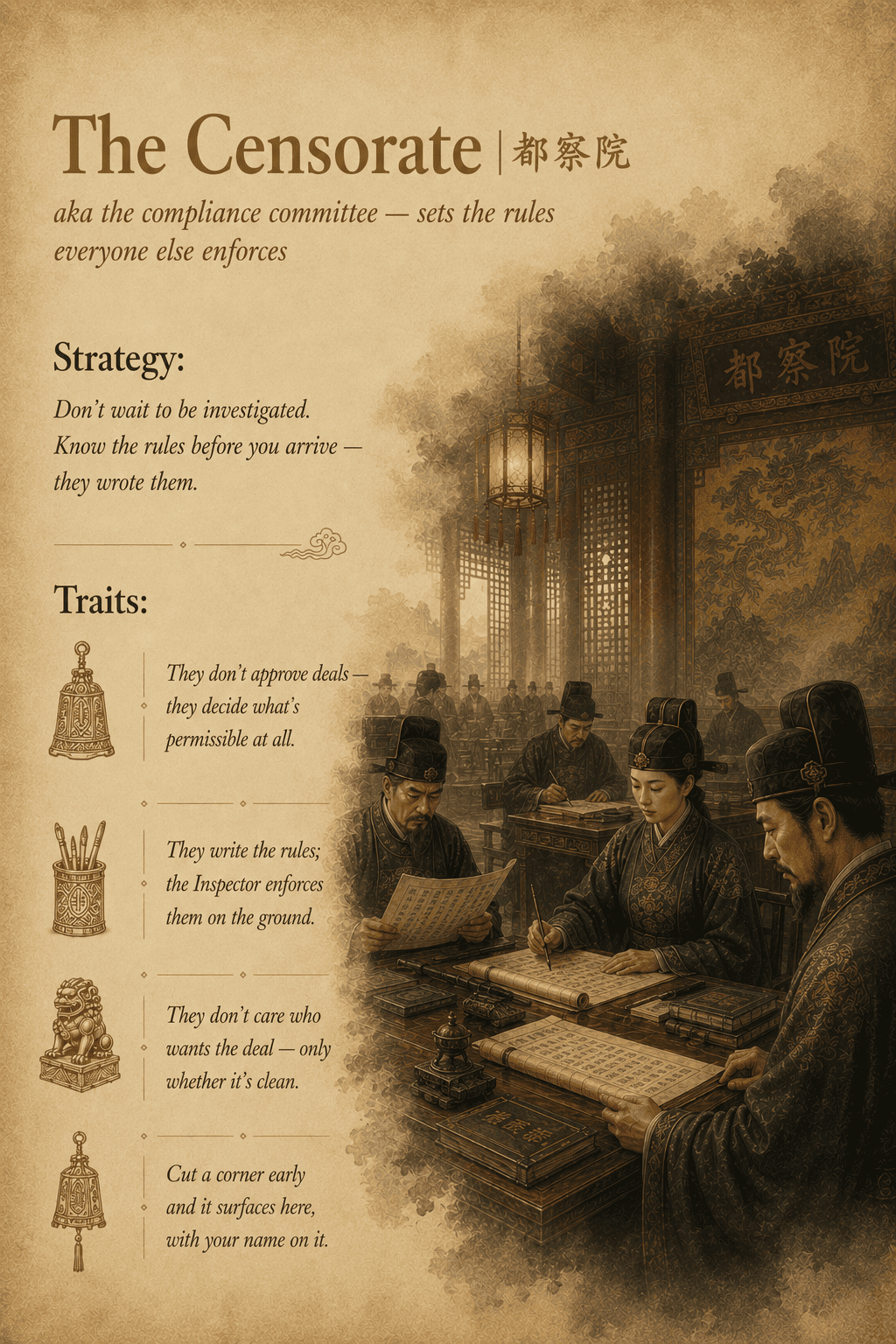
The Censorate
The Censorate
The Compliance Committee — they set the rules the court enforces.
The Rules
Where the power comes from

They set the rules the rest of the court enforces. Sitting at board level, their role is institutional, not operational — they define what's permissible before anyone debates whether a deal is good.

Upside

Knowing their rules before you arrive turns compliance from an obstacle into a credential. A deal built clean from the start sails through.

Risk

They don't care who wants the deal — only whether it's clean. A process violation surfaces here regardless of how senior your sponsor is.

Works

Learn the rules before you walk in — they wrote them. Build the deal to pass them by design, not by appeal.

Backfires

Waiting to be investigated, or assuming a sponsor's enthusiasm covers a process gap. The rules apply above your sponsor, not below.

Watch-out · they decide what's even permissible

They don't approve deals — they decide which deals are allowed to exist at all. Clear their framework first, or nothing above it matters.

The Minister
The Minister
President & CEO — the decision-maker for larger deals.
The Pen
Where the power comes from

They hold the operational call for deals at scale — the decision is theirs to make, full stop. That weight sits on the seat and the decision they hold, not on age, tenure, or how senior they look. By the time a deal reaches them it has already cleared the Inspector — a pre-filtered case, not a raw one.

Upside

Their yes is the operational deal for anything of scale. Win them and the case moves cleanly upward — sponsor, inspector, ally already aligned.

Risk

Their no is final at this level. They don't out-argue you — they simply decline. They can close a sound deal on conduct alone, and do.

Works

Arrive pre-cleared through the Inspector. Bring scope, financials, risk named. Make it easy to say yes; treat scrutiny as the job.

Backfires

Out-arguing them, going over their head to the sponsor, or skipping the gates below. It tells them you don't understand the court.

Watch-out · they decide on conduct as much as merits

What they're really reading is whether you're someone the house can work with at scale and over time. The numbers are table stakes. Stay composed when they're testing you — because the test is the composure.

The Circuit Inspector
The Compliance Officer — sometimes the one holding the pen.
Compliance
Where the power comes from

Not command — scrutiny. Their standing right is to ask "is this sound?" and be heard. On smaller deals they hold the pen outright; on larger ones their report shapes what the Minister sees. That weight sits on the seat, not on age or seniority.

Upside

An inspector who signs off is the strongest validation in the court. Win them on a small deal and you're done; on a big one you reach the Minister cleared.

Risk

A single credible objection stalls or kills — raising it is often enough. They report independently, above the Minister's desk.

Works

Win them early with clean material — never charm or the sponsor's name. Bring them in early and let them find nothing.

Backfires

Questioning their authority on age, taking scrutiny personally, or moralizing at them in front of the sponsor. Each hands them the charge that sticks.

Watch-out · they brief the Minister, and answer to the Grand Censor

When the Grand Censor probes in the review room, the Minister leans on the Inspector to fill the detail they don't carry — so arm the Inspector well, because they defend your deal in rooms you'll never sit in.

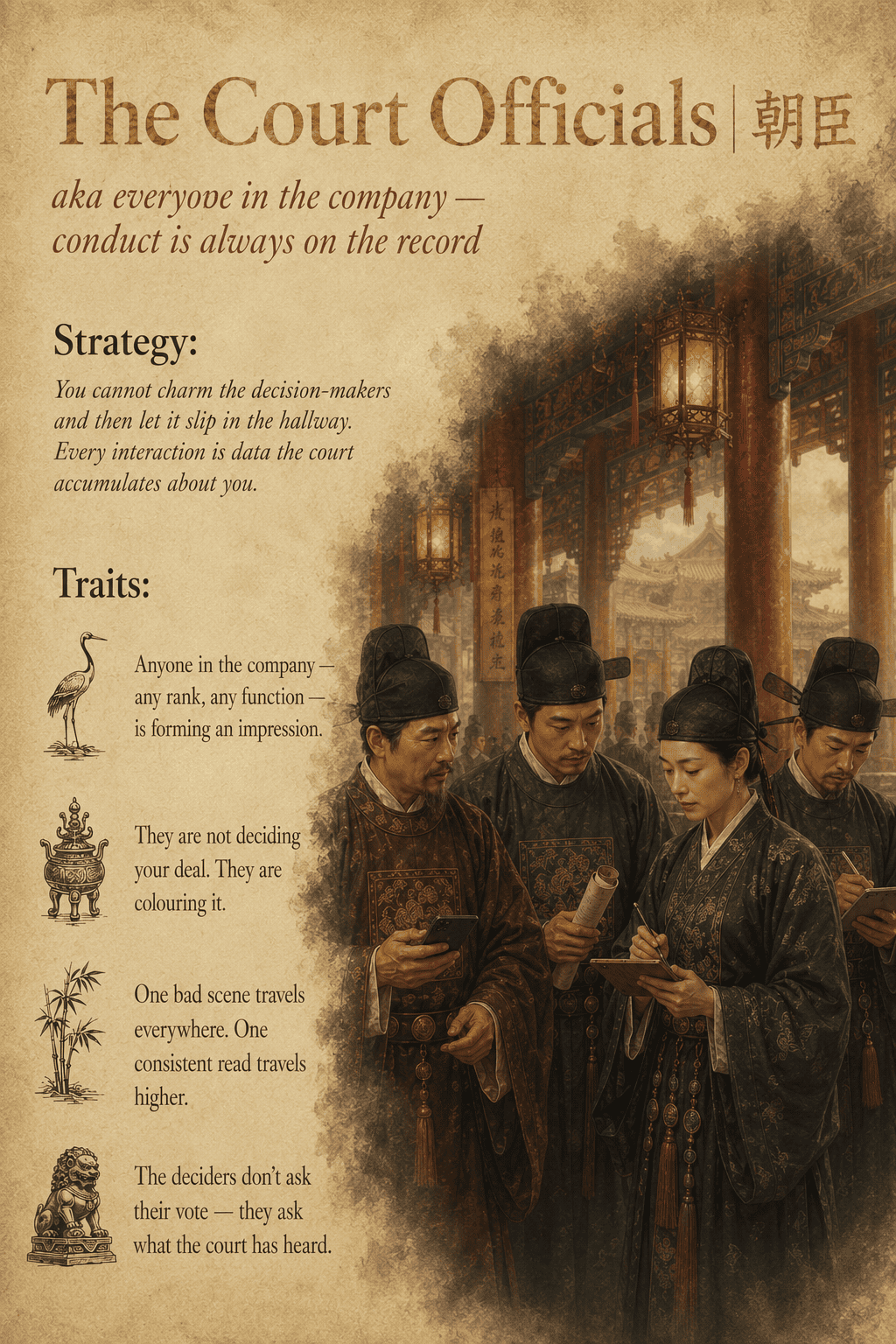
The Court Officials
The Court Officials
Everyone in the company — conduct is always on the record.
The House
Where the power comes from

No single person — the whole house. Every person you encounter, at any rank, in any function, is contributing to a reputation that forms before you ever reach the seat that decides. The court is one organism. It has a collective read on the outsider, and that read circulates into rooms you'll never enter.

Upside

Win them and you're already legible — "he's easy to work with, comes prepared" travels ahead of you into rooms that matter. A cleared path.

Risk

Lose them and the door shuts in ways you'll never trace. No complaint is filed. The energy just changes — and you won't know until a response stops coming.

Works

Be consistent regardless of who is watching. As sharp and prepared in the smallest meeting as in the biggest. Treat every person as if their view reaches the top — because it does.

Backfires

Performing for decision-makers and letting your guard down everywhere else. The hallway, the side meeting, the reply to a junior email — all part of the record the court builds on you.

Watch-out · this is not one relationship — it's a reputation

You're not managing a single seat here; you're managing how the whole house reads you. It's built continuously from the moment you walk in, in every room, at every level. There's no off switch.

The Investigation Bureau
The Compliance Department — their notes become the record.
On the Ground
Where the power comes from

They execute the review on the ground — present in every key meeting, noting everything. Junior in rank, but their notes become the official record that the Inspector, and everyone above, reads.

Upside

Hand them clean, complete material and you're writing the Inspector's first impression of your deal. Make their job easy and the record favours you.

Risk

A bad impression in front of them fades; their written note doesn't. What they observe feeds the Inspector — and the whole court.

Works

Treat the most junior person in the room as if they report straight up, because they do. Give them accurate material and never make them chase you.

Backfires

Dismissing them as too junior to matter, or behaving carelessly because "no one important" is watching. They are exactly who's watching.

Watch-out · their notes outlive the moment

The room's most junior figure is building the record that protects — or indicts — your deal. How you treat them, and what you hand them, is on paper long after the meeting ends.

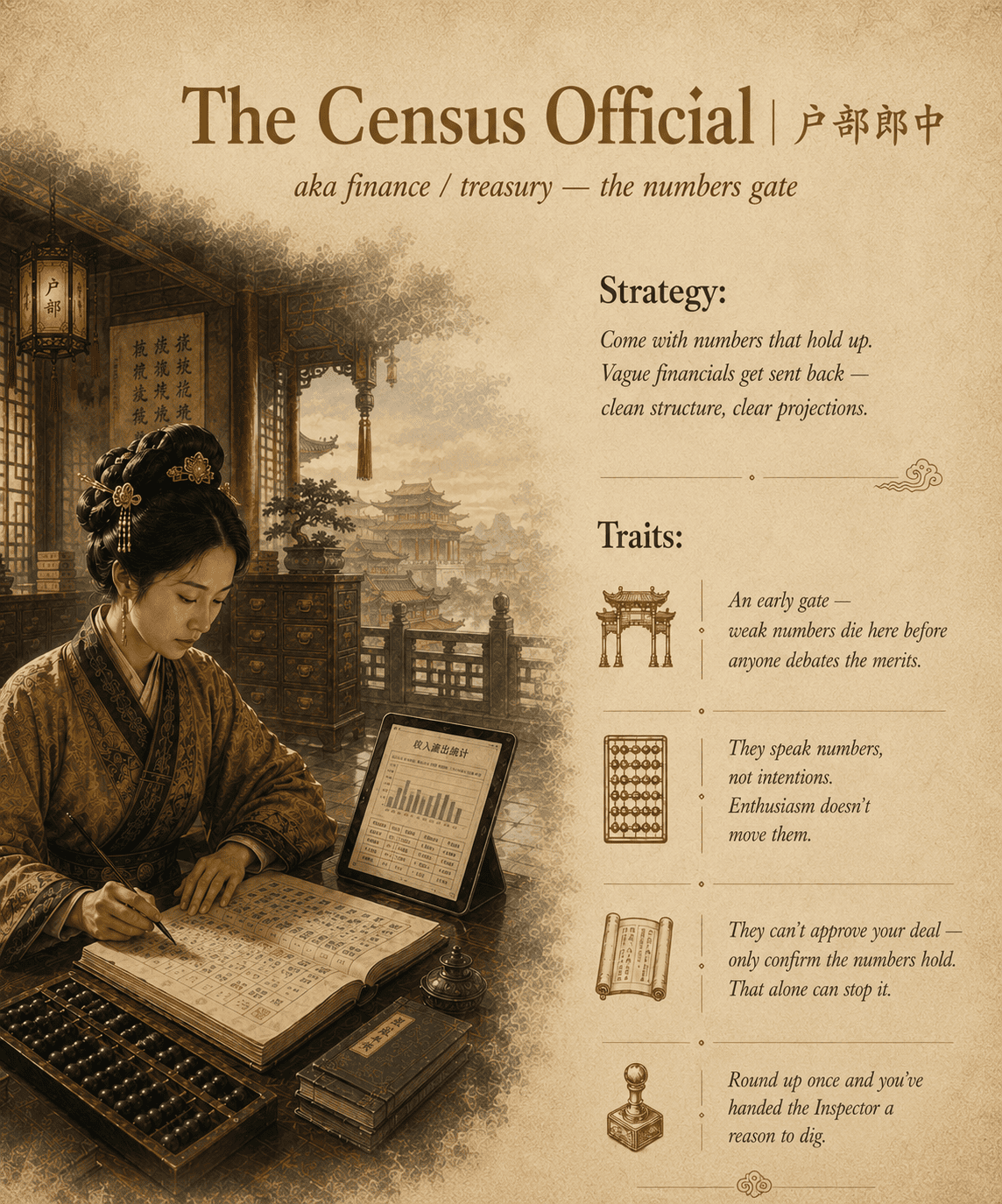
The Census Official
The Census Official
Finance & Planning — the numbers gate.
Numbers
Where the power comes from

They hold the numbers gate. Methodical and precise, they deal in figures, not intentions — and nothing moves until the financials hold up. An early gate, lower in rank but unavoidable.

Upside

Clean numbers here clear you before the merits are even debated — you arrive upstairs with the financial question already settled.

Risk

Weak financials die here first. They can't approve your deal — but confirming the numbers don't hold is enough to stop it.

Works

Bring figures that hold up: clean structure, clear projections, defensible assumptions. Make the math easy to verify.

Backfires

Vague or inflated numbers. Round up once and you've handed the Inspector a reason to dig — a finance flag upstream is hard to walk back.

Watch-out · they speak numbers, not enthusiasm

No amount of vision moves them. Treat this as a case to be verified, not a pitch to be sold — and never let the financials be the soft spot someone above can poke.

The Circuit Governor
The inside operator who brought you in.
Your Ally
Where the power comes from

The inside operator who brought you in. He runs real territory and carries delegated authority — and he's accountable for how your deal goes. He manages two things at once: you, and the compliance bureau, keeping both clean for the Minister.

Upside

A warm, capable ally inside who can guide you, translate your case, and vouch for you to people who don't yet know you. His credit got you in.

Risk

His credit is finite. Perform below the standard he implied and you spend it — and if you blow it, it lands on him.

Works

Come in prepared and behave well, so you never make him defend work he didn't do. Let him guide you — then win the court yourself.

Backfires

Treating him as the person who builds your whole case. He can translate your case — he can't be it.

Watch-out · a warm ally is not a closed deal

An inside friend gets you a hearing, not a yes. Don't mistake his support for the decision — and don't spend the credit that opened the door in the first place.

The Envoy
使
The Envoy
You — the outsider who came to strike a deal.
This is You
Where the power comes from

You start with none of the court's authority — you're the outsider, and everything you carry, you carry in. Your power is your case, your conduct, and the door a sponsor opened for you. Everything else, you earn.

Upside

A genuinely good deal, brought in clean and navigated well, is hard to stop. You know what you want — handled right, that clarity is leverage.

Risk

You can be entirely right on the merits and still lose — on conduct, on impatience, on misreading the room. Enthusiasm won't carry you through.

Works

Come in with your own structured case, not questions for the ally to answer. Navigate the court seat by seat; win the gatekeepers.

Backfires

Treating a sponsor's "yes" as the deal, fighting the people who hold the pen, or taking scrutiny personally. Each loses a deal the numbers should have won.

Watch-out · the deal is good — don't let conduct kill it

The merits are rarely what fail. Walk through the door the sponsor opened, earn the room, find the pen, win the gatekeeper — and the deal you brought is still standing when you leave.

The takeaway

The whole guide in one line

Earn the room. Find the pen. Win the gatekeeper.

The Forbidden Office takeaway

The merits are rarely the problem. Walk in understanding how the machine thinks — and the deal you brought is still standing when you leave.

A court does not run on "the boss wants it." A sponsor's yes is a door, not a deal. Power sits on the seat and the decision it holds — not on age, warmth, or how long someone's been there. And a good deal dies on conduct far more often than on numbers.

Bring your own case. Read the room before you read your pitch. Treat every standard question as the job, not an insult. Win the people who hold the pen — and let a clean result climb the court on its own.

The Forbidden Office · a field guide for the outsider · archetypes, not real people